

Nervous about getting tested? Totally understandable.
Sometimes making the decision can feel harder than the process itself.
In this post, we’ll shine a light on fertility testing so it becomes less daunting for couples. In the end, you’ll see it as a way for you and your doctor to maximize your chances of success.
Difficulty conceiving is a medical issue, and not a measure of your worth, femininity/masculinity, or your ability as a parent.

Baby Steps…
Now, if you and your partner are having a hard time getting pregnant, you might want to find out why so you can do something about it.
Every couple’s fertility testing journey looks a little different.
Your doctor may recommend certain tests earlier, skip others, or take a different route altogether depending on your situation.
What follows is a general guide, not a fixed formula. It’s meant to give you the big picture and demystify fertility evaluations.
Let’s begin.
Step #1: Initial Assessment
It begins with a conversation.
Your doctor will want to know how long you've been trying, your ages, how often you engage in sex, and whether your menstrual cycles are regular.
You will be asked about medical conditions, surgeries, infections, medications, and any previous fertility problems.
For the woman, the menstrual cycle can provide useful clues. Regular periods often suggest that ovulation is occurring, while very irregular or absent periods suggest an ovulation or hormonal issue.
For the man, the doctor may ask about sexual health and function, previous illnesses, medications, surgeries, injuries, and anything that could affect sperm production.
The goal at this stage isn’t to find every possible problem. It is to identify the most likely source/s of the issue.

An honest conversation with your doctor will bring to attention not just the physical or biological side of things but also the relationship dynamics that may be getting in the way.
There is a tendency to think of fertility as a purely biological endeavor. We imagine hormones, sperm, eggs, fallopian tubes, diets and blood tests. But getting pregnant also depends on what is happening in a couple’s actual life.
For example, work can consume so much time and energy that sex becomes something squeezed in between deadlines. Stress can affect desire, sleep, and sexual function.
A couple may be under financial pressure, dealing with conflict, or carrying emotional problems that make intimacy difficult. Sometimes partners are simply having less contact than they realize, or not at the times when conception is most likely.
In addition to your medical history, these things are put into consideration at the initial assessment.
Step #2 Basic Testing
Once the doctor has a sense of the situation, the next step is usually the basic fertility workup where both partners are evaluated.
For Him:
One of the first tests is a semen analysis. This test looks into the sperm, including:
Sperm count: Are there enough sperm being produced?
Motility: Are the sperm moving well enough to reach an egg?
Morphology: Do the sperm have a typical shape and structure?
Semen volume and other characteristics: Is the semen itself within expected ranges?
A semen analysis can reveal problems like low sperm count or poor sperm movement. If something is abnormal, that doesn't automatically mean a man cannot father a child, but it will spur an investigation into a possible underlying cause.
For Her:
Blood tests and ultrasound are done to start looking into possible causes of fertility issues.
Three basic questions need to be answered:
a) Is she ovulating?
Ovulation is when an egg is released from the ovary. If it isn't happening regularly, getting pregnant can be difficult.

b) How are the ovaries functioning?
Doctors may assess ovarian reserve, which gives information about the remaining supply of eggs. Blood tests that look into specific hormones help determine this.
c) Do the reproductive organs look healthy?
A pelvic ultrasound can provide insight into the uterus and ovaries and may identify issues such as fibroids, ovarian cysts, or other abnormalities.
At this stage, we’re looking at general and common fertility issues. If something stands out, the next tests become more focused.
Step #3. Identifying Which Branch Has A Problem
Fertility issues can involve either partner…sometimes both.
When the results of the fertility workup come out, doctors naturally want to know “Why is this happening?” or “Why is this NOT happening?” They would also want to look more closely and more specifically at the possible issue.
If there's a sperm problem
An abnormal semen analysis may warrant another look. Sperm counts and quality can change significantly from day to day, so a confirmatory test is done to determine a baseline. If both tests remain abnormal, your doctor may recommend hormone testing, ultrasounds, or a referral to a fertility specialist to find the underlying cause.
If there's an ovulation problem
If ovulation appears irregular or isn't happening, a doctor may check for hormones such as progesterone, TSH, or prolactin, along with other reproductive hormones. The exact tests depend on the woman's symptoms and menstrual cycle.
Also, the doctor may want to test for PMOS (Polyendocrine Metabolic Ovarian Syndrome), formerly called PCOS (Polycystic Ovary Syndrome).
If there's a concern about egg reserve
If there's a reason to assess ovarian reserve, doctors may use AMH, FSH, estradiol, and antral follicle count. These provide insight into ovarian function and the state of the eggs, which guide fertility treatment.
If there's a possible tubal problem
The doctor may investigate whether the fallopian tubes are open. A blocked tube can prevent sperm and egg from meeting even when ovulation and sperm production are normal.
If there's concern that the tubes may be blocked, an HSG (hysterosalpingogram) may be recommended. It uses imaging and contrast material to check whether the tubes are open and can also show certain abnormalities in the uterus.
If there's a possible uterine problem
A sonohysterography, or saline infusion sonogram, is a safe test that uses sound waves and a small amount of sterile salt water injected into the uterus to create clear pictures of the uterine lining. This can help find polyps or fibroids inside the womb, check for unusual womb shapes, and find causes of unexplained bleeding or repeated miscarriages.
If imaging suggests a problem, the doctor may recommend a procedure such as hysteroscopy, which allows the inside of the uterus to be examined directly.
But sometimes, everything looks normal.
This can be frustrating, but it happens. That doesn't mean there is no biological reason for the difficulty. It means the standard tests haven't identified it.
Step #4 Specialized Testing
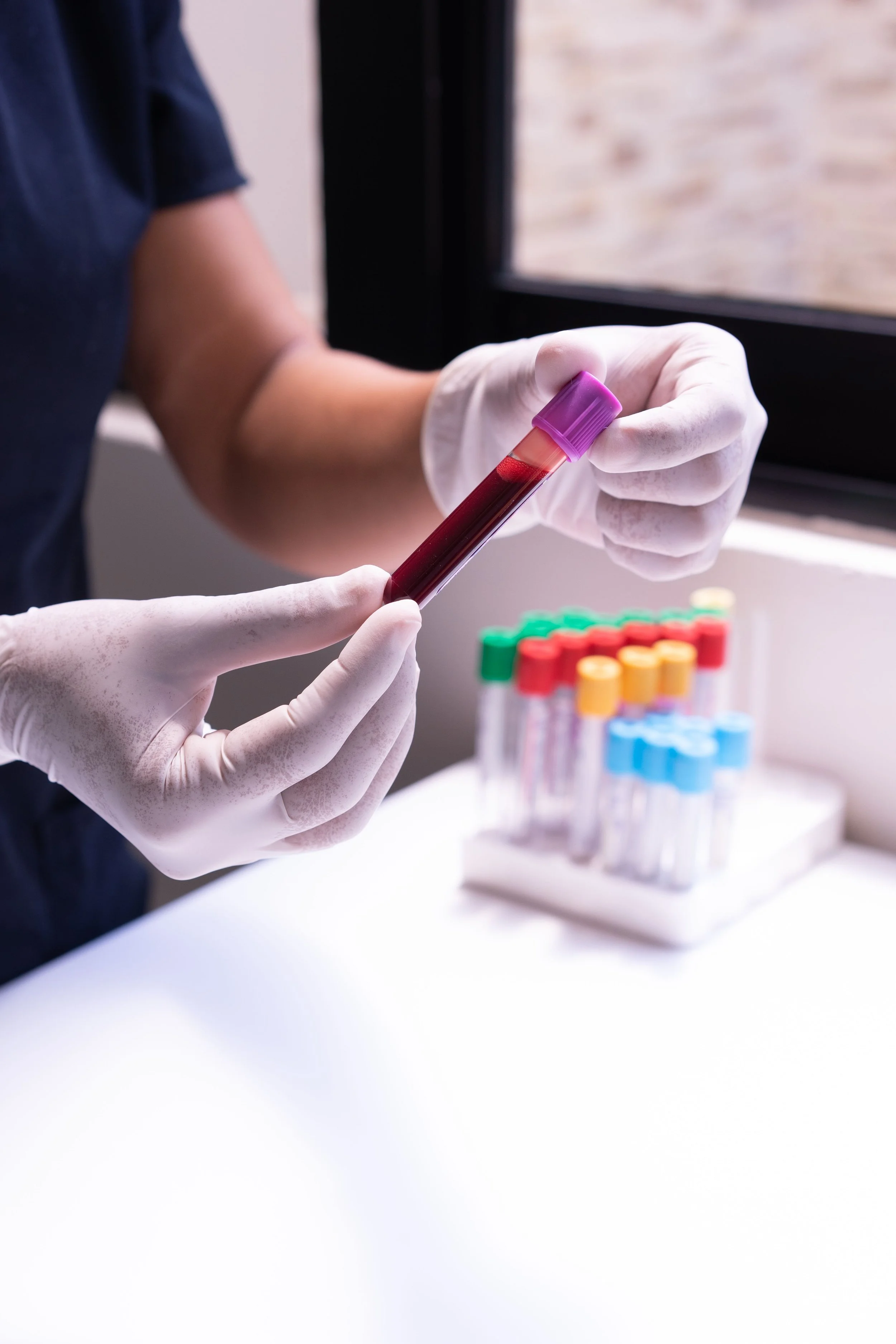
For some couples, the standard fertility workup still doesn't answer the question. Others may have a history that makes a particular problem more likely from the start.
This is where highly specialized testing may enter the picture.
Think of advanced testing as a response to a specific question:
Could an immune-related problem be involved?
Is there a particular blood-clotting issue worth investigating?
Could there be a specialized sperm or genetic factor that hasn't been addressed by the basic workup?
Depending on the situation, a fertility specialist may consider tests such as APAS testing, anticardiolipin antibodies, lymphocyte or NK-cell testing, Protein C, Protein S, Factor V Leiden, anti-sperm antibodies, or other specialized reproductive and genetic tests.
These tests look at very specific possibilities, including certain immune or blood-clotting conditions and, in selected cases, factors involving sperm or genetics.
But reaching this stage doesn't mean something serious has necessarily been found. It simply means the doctor has a specific question that the standard evaluation hasn't answered.
For example, a couple with recurrent pregnancy losses will spur your doctor to look more closely into possible causes.
So there’s no universal fertility testing package that every couple needs. The exact steps depend on your history, test results, and what they are telling your doctor.

If you've been trying to have a baby without success, fertility testing can seem like a long list of unfamiliar tests.
The process generally starts with the basics, and then becomes more targeted as we learn more about your situation.
BloodWorks Lab is your partner in this journey, offering advanced repro-immunological blood tests and fertility assessments. We are the one-stop shop for an expectant couple’s blood test needs.
Book your appointment today.
Our branches are in Alabang, Katipunan, and Cebu.